
Professional Bookkeeping Services India | Bharat Comply
Accurate and reliable bookkeeping services for businesses in India by Bharat Comply. Stay financially organised and compliant. Get started today.
Overview
What Is Bookkeeping and Why Does Every Business Need It?
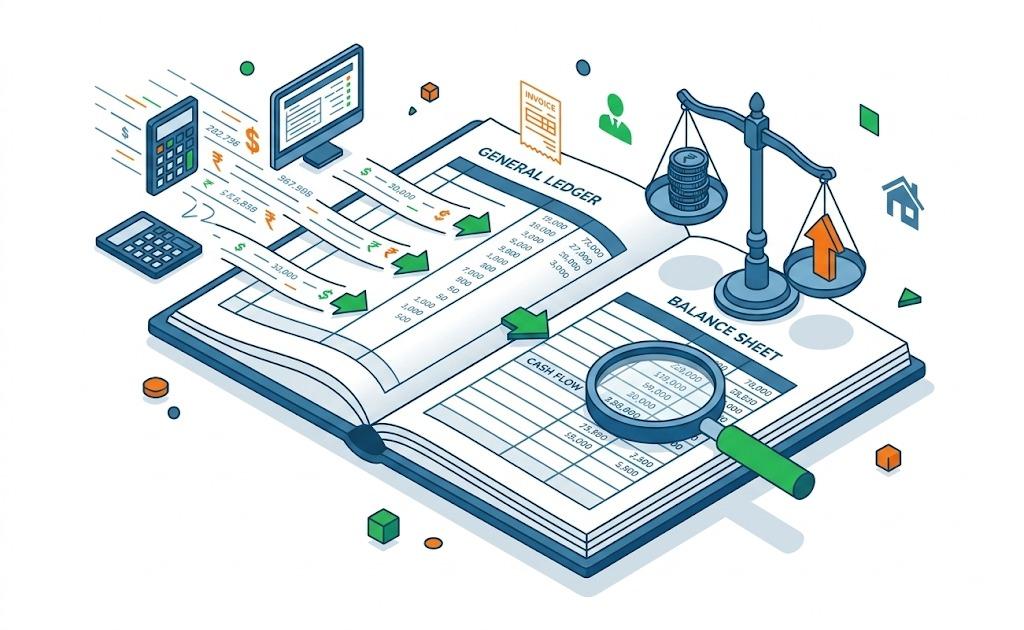
Bookkeeping is the systematic process of recording, organising, and maintaining a business's financial transactions on a day-to-day basis. Every sale, purchase, payment, receipt, bank transfer, and expense must be recorded in an organised ledger so that the business knows exactly where its money comes from and where it goes.
Under the Companies Act, 2013, every registered company is required to maintain books of accounts that give a true and fair view of the company's financial affairs. These books must be kept at the registered office, maintained on an accrual basis using the double-entry system of accounting, and preserved for a minimum of eight years. For LLPs, the LLP Act, 2008 has similar requirements. For sole proprietors and partnership firms, the Income Tax Act requires books to be maintained if turnover crosses specified thresholds.
Despite being a basic requirement, poor bookkeeping is one of the most common reasons businesses face problems during GST audits, income tax assessments, statutory audits, and investor due diligence. Clean, up-to-date books of accounts make every other compliance function faster, cheaper, and more accurate.
What Does Bookkeeping Include?
Bookkeeping covers the following core activities:
Recording Daily Transactions
Every financial transaction is recorded as a journal entry in the accounting system. Sales are recorded when invoices are issued. Purchases are recorded when bills are received. Payments and receipts are recorded when bank transactions occur. Expenses such as rent, salaries, utilities, and professional fees are recorded as they accrue.
Bank Reconciliation
Bank reconciliation is the process of matching the transactions in the business's accounting records with the transactions appearing in the bank statement. This identifies discrepancies such as uncleared cheques, bank charges not recorded in the books, or deposits in transit. Monthly bank reconciliation is a basic internal control that every business should maintain.
Accounts Receivable and Payable Management
Accounts receivable track what customers owe the business. Accounts payable tracks what the business owes to suppliers and vendors. Maintaining accurate ledgers for both ensures the business can chase overdue payments, manage cash flow, and avoid paying the same bill twice.
Payroll Accounting
Recording salary payments, provident fund contributions, professional tax deductions, and TDS on salaries accurately is part of the bookkeeping function. Payroll entries must reconcile with actual bank transfers and with TDS returns filed with the Income Tax Department.
GST Ledger Maintenance
Every business registered under GST must maintain a separate ledger for input GST paid on purchases and output GST collected on sales. The difference between these two determines the net GST payable or the ITC available for set-off. Accurate GST ledger maintenance is essential for filing correct GSTR-1 and GSTR-3B returns.
For businesses that want their bookkeeping records used directly to support accurate GST return filings, Bharat Comply's GST Return Filing service works from organised bookkeeping data to prepare and file all required returns on time.
What Is the Difference Between Bookkeeping and Accounting?
This distinction matters when you are deciding what kind of support your business needs.
Bookkeeping is the ongoing, systematic recording of financial transactions. It is the input function. The bookkeeper records what happened: money received, money spent, assets purchased, liabilities created.
Accounting uses the recorded data to produce financial statements, perform analysis, and generate insights. The accountant interprets the data: preparing a profit and loss statement, evaluating margin trends, calculating tax liability, and advising on financial decisions.
In practice, for small and medium businesses, both functions are often handled by the same professional or firm. However, they require different skills and serve different purposes. Bookkeeping must be accurate and current for accounting to be meaningful.
What Accounting Software Is Used for Bookkeeping in India?
Tally Prime
The most prevalent accounting software for Indian SMEs. It handles GST-compliant invoicing, TDS management, payroll, and inventory. Bank reconciliation and GST return data export are built into the software. Most Indian accountants and bookkeepers are trained in Tally.
Zoho Books
A cloud-based accounting platform that integrates with the GST portal for return filing, connects to bank feeds for automatic transaction import, and supports multi-user access. Particularly suitable for businesses that want their founders to have real-time visibility into financial data from any device.
QuickBooks
Widely used by businesses with international operations or those that have adopted global accounting standards. Less dominant in the Indian market than Tally, but suitable for tech startups and companies with foreign investors.
Microsoft Excel
Many micro businesses and early-stage startups maintain books in Excel. This works for very simple transactions, but becomes unmanageable as volume grows and audit trails become necessary.
Bharat Comply works with Tally Prime and Zoho Books for client bookkeeping engagements, ensuring compatibility with GST return filing, TDS compliance, and statutory audit requirements.
What Are the Legal Requirements for Maintaining Books of Accounts?
Under the Companies Act, 2013
Section 128 of the Companies Act requires every company to maintain books of accounts at its registered office, or at another location notified to the Registrar of Companies. Books must be maintained on an accrual basis using the double-entry system. The financial year for all companies is April 1 to March 31. Books must be preserved for eight years from the end of the relevant financial year.
Under the Income Tax Act, 1961
Section 44AA requires specified professionals (doctors, lawyers, CAs, engineers, architects, and others) to maintain books of accounts if gross receipts exceed Rs 1.5 lakh in any of the three preceding years. For businesses, books are required if income exceeds Rs 1.2 lakh or turnover exceeds Rs 10 lakh in any of the three preceding years. Businesses opting for presumptive taxation under Section 44AD or 44ADA are exempt from this requirement.
Under the GST Law
The CGST Act requires every registered taxpayer to maintain accounts and records of production or manufacture, inward and outward supply, stock, input tax credit availed, output tax payable and paid, and other prescribed records. These records must be maintained at the principal place of business for a period of 72 months (six years) from the due date of filing the annual return.
For companies that need their bookkeeping to integrate seamlessly with annual statutory filings, Bharat Comply's Annual Filing service uses the bookkeeping records maintained throughout the year to prepare ROC filings, income tax returns, and coordinate the statutory audit without duplication of effort.
What Does Bharat Comply's Bookkeeping Service Include?
Bharat Comply provides monthly bookkeeping services for private limited companies, LLPs, sole proprietors, and partnership firms using Tally Prime and Zoho Books.
Our bookkeeping service includes:
- Recording all sales, purchases, receipts, and payment transactions
- Monthly bank reconciliation for all operating accounts
- Accounts receivable and payable ledger management
- Payroll entries and reconciliation with TDS and PF obligations
- GST input and output ledger maintenance reconciled with GSTR-2B monthly
- Monthly trial balance and profit and loss statement
- Preparation of books for statutory audit at year-end
- Data export and reporting in formats required by your CA or auditor
Our bookkeeping service is designed to work alongside your statutory audit, income tax filing, and Virtual CFO functions, so there is no duplication or data inconsistency across your compliance stack.
For businesses that need financial strategy and investor reporting built on top of accurate bookkeeping, Bharat Comply's Virtual CFO service uses the monthly books maintained by our bookkeeping team to produce MIS reports, cash flow forecasts, and board presentations.
For businesses that are in the process of registration and want bookkeeping set up correctly from day one, Bharat Comply's startup company registration service includes guidance on setting up your accounting system as part of the post-incorporation checklist.
Key Benefits
Our Process
Collect Financial Records and Documents
We collect your invoices, purchase bills, bank statements, expense proofs, payroll records, and GST data to begin the bookkeeping process accurately.
Record Transactions in Accounting Software
All business transactions are recorded systematically in Tally Prime or Zoho Books using proper accounting standards and double-entry bookkeeping.
Perform Bank Reconciliation
We reconcile all bank transactions with your accounting records to identify discrepancies, missed entries, or pending transactions.
Maintain GST and Ledger Records
Input GST, output GST, receivables, payables, payroll entries, and other ledgers are updated and reconciled regularly for compliance readiness.
Generate Monthly Financial Reports
We prepare monthly trial balances, profit and loss statements, and accounting reports required for compliance, audits, and management decisions.